(Peter McClusky, right, with fellow interns from Whole Circle Farm during his 2010 internship) To see more photos and learn about my journey from New York City to farm, and to Toronto (my home city) to start the Toronto Garlic Festival, you're welcome to wander through my blog.
To reduce waste at the 2022 Festival, and to prepare for the Federal single-use plastic ban, we partnered with Dream Zero (dreamzero.ca), a Canadian company that rents reusable dishware for public events and food businesses.
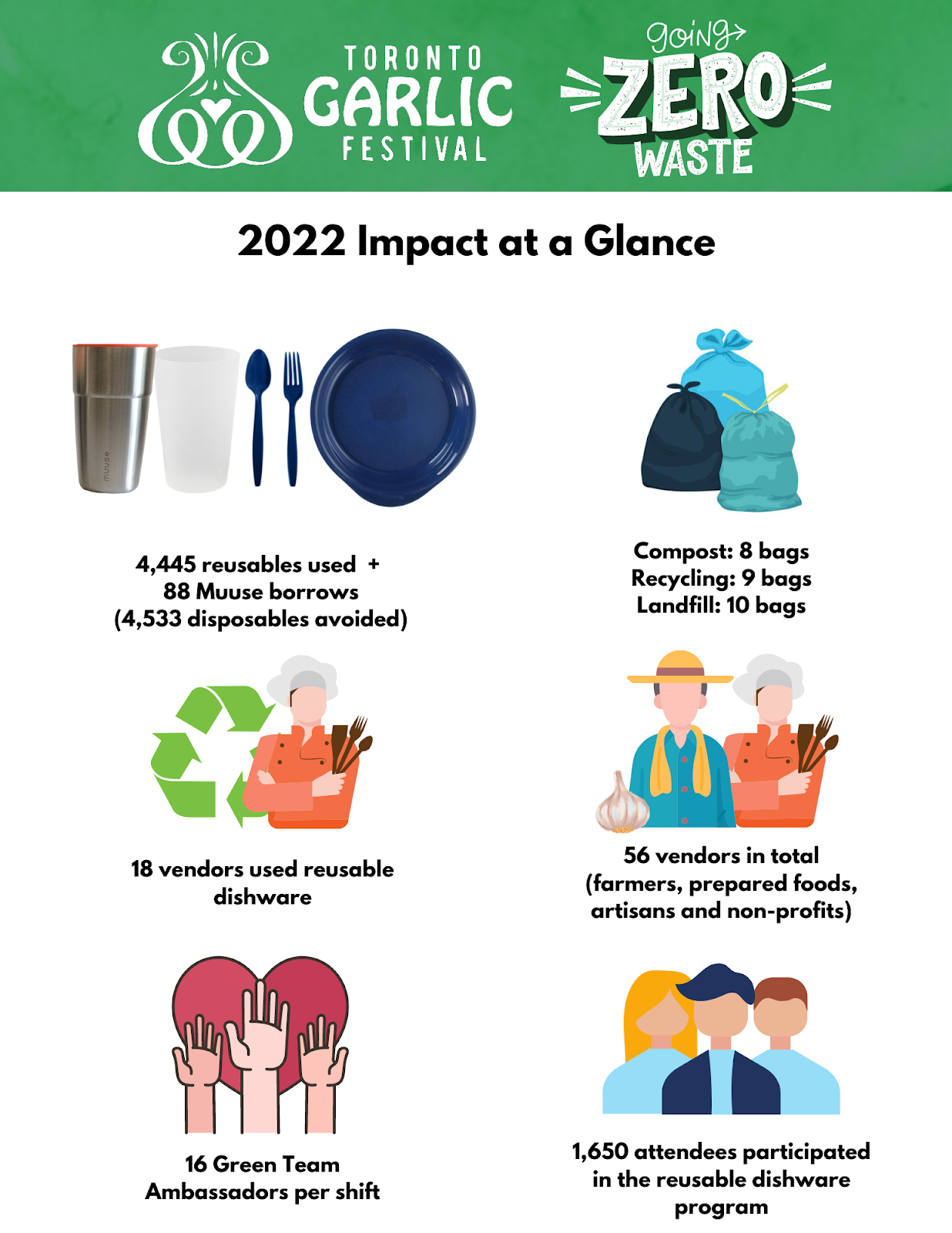
With 18 vendors in participation, we achieved an estimated 65-75% decrease in waste. We hope that the methods and lessons learned from our Waste Reduction Project inspires other event managers to make waste-reducing changes.
Toronto Garlic Festival has created the Ontario Garlic in the Classroom lesson plan. Starting with Autumn planting this versatile guide takes students on the garlic growing journey through the school year. It incorporates modules in Math, Science, Humanities and Language Arts and is suitable for grades 3-5 but is easily adapted for other grades. Garlic is a forgiving plant offering great rewards.

• It brings them closer to the soil
• It helps them gain a better understanding of where food comes from
• It gives them an opportunity to participate in a team activity
• It helps them understand their connection to other cultures through garlic
• It channels their new-found interest in Ontario garlic into an interest in cooking and diet
Ontario Garlic in the Classroom Student Guide and Teacher’s Guide are available to download for free on Toronto Star’s Classroom Connection.
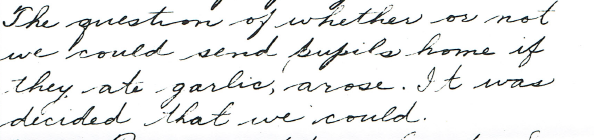
This Garlic Growing handbook is a step forward from 1928, when a meeting of the trustees and teachers for a school near Sudbury debated whether students who smelled of garlic could be admitted to class. “The question of whether or not we could send pupils home if they ate garlic, arose. It was decided that we could."

https://www.quantamagazine.org/a-soil-science-revolution-upends-plans-to-fight-climate-change-20210727/
A business marketing story to
help us think about the challenge of attracting certain parts of the
market for our new e-com store, is Alfred Sloan's classic, "My Years at General Motors."
Until the 1920’s Henry Ford dominated the automobile market with his factory produced cars and low price. He could build cars cheaper than his competitors and he dominated the market based on price by building just one model: The Model T. Car buyers back then saw the automobile as just a form of transportation, nothing more. Cars as a commodity. So they were happy to own Ford Model T.
GM challenged this paradigm and grew to be one of the dominant automobile makers in the world. How did they do this? One of their weapons was through product segmentation and in understanding their market. They changed the public’s perception of the automobile from just a means of getting around to being a symbol of status and luxury. They created several models, from the low priced Chevrolet to the high priced Cadillac, each targeted to a different market segment. Thanks in part to their product and marketing strategy GM eventually surpassed Ford Motor Company.
This is not a perfect
comparison, but to look at garlic in context of Ford vs General Motors gives a
sense of the challenge. For us, the equivalent of Ford is cheap imported
garlic. Many consumers see garlic as a commodity, sure it’s a desirable flavour
in their food, but it’s seen as one dimensional, sharp and strong. They
wouldn’t consider paying more than $2 or $3 per pound. They were like the early
buyers of the Model T. Our challenge is the same challenge that General Motors had over 100 years ago: How to make Ontario garlic and the products made with it, attractive to the segment of the population that sees garlic as a commodity, an essential ingredient maybe, but not worth more than the price paid for imported garlic.
A morning glory seedling seems to have broken its stem. Its hanging on by a thread. Still getting nutrients, the young leaf is doing ok. But if this little guy is gonna survive I'll have to make a splint.


 |
| 2010 (Back l-r: Devon, Monique, Farm stewards Maggie & Johann, Peter; Front l-r: Andrew, Heather, Nana, Farm Manager Abi; Far back in hat: Rob) |
 I was in KFC (I get cravings) and saw a rustic looking sign claiming that their chicken is, "Farm Raised." Wait a second. All chickens are raised on a farm. Whether it's a one acre hobby farm or a 1,000 acre commercial complex, both are a type of farming. Clearly KFC is appealing to our sentimentalized idea of farming.
 Fashion designer Karl Lagerfeld "turned the vast glass nave of Paris’s Grand Palais into an autumn forest for the event, strewing dead leaves, moss and logs on a mirrored runway and installed nine tall trees inside."
 Deborah and I got back Sunday night from a week in a cabin on Penyck Lake, near Sharbot Lake, Ontario. It was advertised as an “off-the-grid tiny cabin”. I loved it because it reminds me of one of the best jobs I ever had: when I was 19 years old I had a summer job as a bush cook 400 miles north of Sault Ste Marie in a 12 man mineral exploration camp, with my weekly shopping list - suckling pigs, coho salmon, filling for 30 pies - ordered via ham radio and flown in on a twin otter by Glen, the deaf pilot.
 This rectangular-shaped “tiny cabin” is 160 square feet of main floor space; plus two small lofts, one at each end, up a 6 rung ladder, about 30” from the ceiling, each loft large enough for a double bed. The place was designed and built by millennial artist friends of Deborah. It’s advertised as “off the grid”. There is a solar power unit on the roof, which creates enough battery-sourced power to run the energy efficient lights and the lake water pump. The propane powered furnace wasn’t working so on cold nights we resorted to an electric space heater run off a gas-powered generator. Does that constitute “off the grid”? Hmmm. It’s amusing and maybe a bit worrying, that people think they’re off the grid, when they’re not, actually. The 2 gallon gas container for the electric generator and the propane tank to run the gas stove didn’t sprout from the forest floor.
 The owners told us the night before we arrived to bring our own firewood for the firepit because previous occupants used it up. What!! I figured there must be wood on the cabin property, we’d just have to scrounge. But we hit a bonanza on the drive up. Stopping for a break at the side of Hwy 7 I spotted a pile of chopped wood. It didn’t appear to belong to anyone, and we stuffed it in the back seat. It burned beautifully.
 And there was tons of wood at the place, piled up, in plain view. It was damp and motly, but perfectly good. I couldn’t figure out why they told us to bring wood. But I spotted a few pieces of pretty looking firewood, the size and shape like what you see at gas stations, 3d printed. Ahh ok. They were running low on the perfect sized, cured wood. They didn’t think that visitors would want or know how to use the damp odd-shaped wood in their wood pile. That’s all I could figure out, because it made no sense. Of course, I used lots of their wood when my Hwy 7 wood ran out.
 The best part was the daily, sometimes twice daily, dunk in the lake. It was incredibly cold. But once in, I felt great, and when I got out I wanted to go back in. Then I'd run up to the fire to warm up and nosh. I havn't done crazy drugs like crack, but I compare it to that. Such an incredible high. The great thing with freezing water is, you get the same high again and again as the first time, and you don't destroy your brain. Even Lou, my dog, wanted to go back in, to get another hit of the Penyck Lake high.
 There was a propane barbecue at the cabin. Deborah and I hate those things. They’re fey. They remind me of tv commercials where the car is driving through a forest, with the occupants looking out from behind tinted windows. Propane barbecues, images of a luxury car in a verdant forest, and cabins not-very-much-off-the-grid, they’re props in a marketing driven imitation world or simulacrum. Is having skills on how to truly live off the grid the great contrarian strategy of the 21st century? Instead of owning gold bullion or shares in a water utility company, knowing how to grow food, skin a rabbit and start a fire may be more valuable assets. The few who have true survival skills will prevail. Ok, I’m not going to devote my time and energy to living off the grid, and I should avoid judging people who own a propane barbecue, but the week in the cabin reminds of the stuff we’ve all talked about, that we’re in a kind of Jared Diamond scenario where western civilization is untethered from things crucial to our survival.
 Lovely day speaking to fellow garlic lovers about my book at Plant Work on 4000 Eglinton Ave West. George, my host, is incredibly earnest and was very helpful in getting things set up for the talk.
 Johann Kleinsasser kind of scared me when I met him.He has a terse seeming tone to his voice that can put you off at first, but then you realize he's a gentle soul. Luckily I got past that and became an intern on his farm, Whole Circle Farm, in 2010.


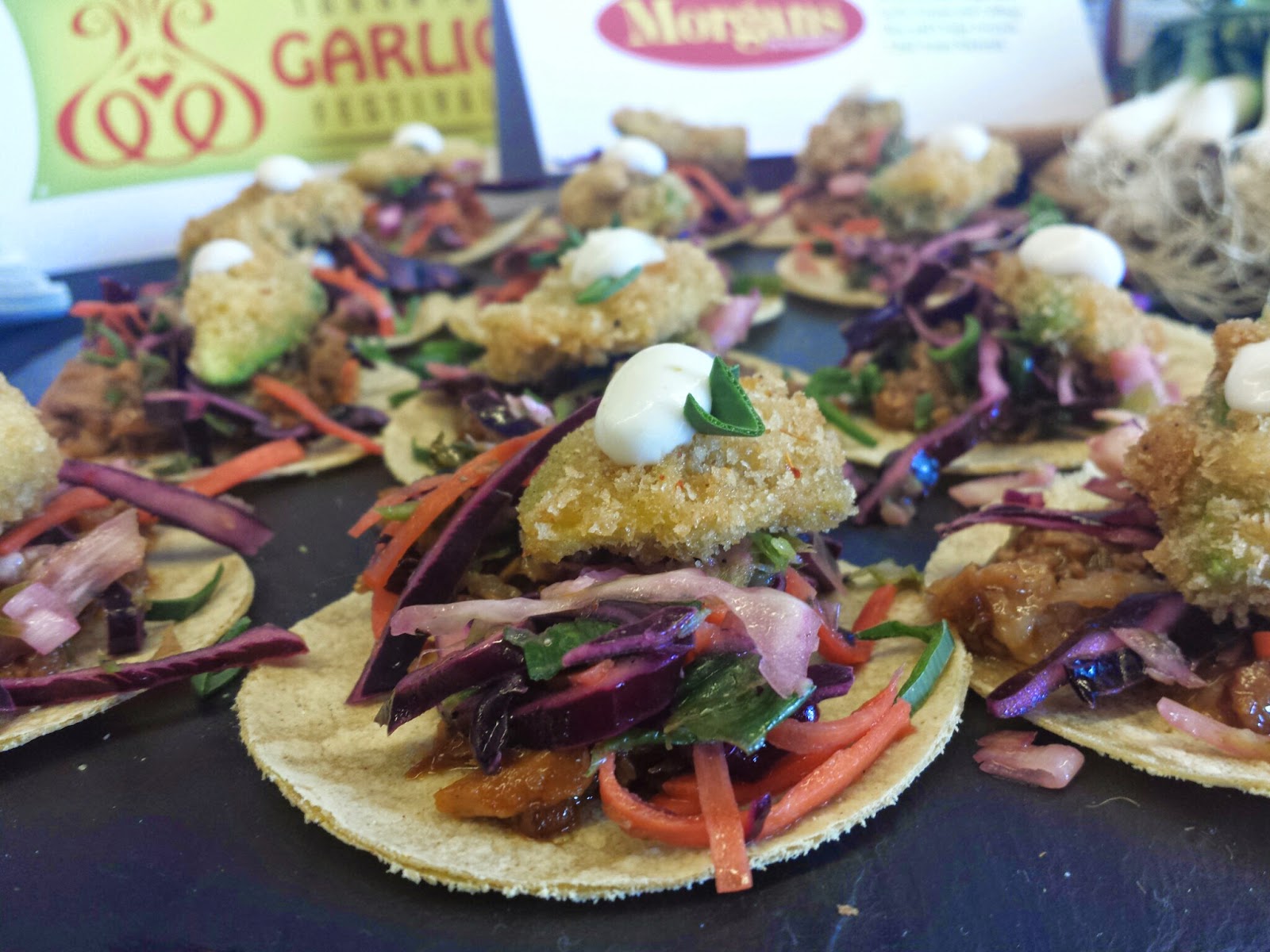 |
| Chef Sorrenti's Taco Nixtamal with Garlic Braised Beef, and Garlic Greens and Cabbage Slaw |
 |
| Chef Anne Sorrenti centre left |